New commercial buildings, from a bare site.
Ground-up commercial construction across South Australia, Victoria and New South Wales. Offices, education and community facilities, clinics and mixed-use buildings.
- Project capacity under a single contract
- $20m
- States we build in: South Australia, Victoria and New South Wales
- 3
- JCGAU builder licence
- BLD 344769
- Years of the director’s delivery experience
- 15+
The premise
On a new build, the site is rarely what sets the date.
Approvals, service connections and long-lead elements are all decided off-site, by people who do not work for you, on timelines you cannot compress.
A new building is the one project type where the construction programme is the shorter half of the story. Between a decision to build and a slab pour sits a sequence of consents, referrals, utility applications and procurement commitments, and each of them has a queue.
So the first thing we do on a new build is not price the building. It is map what has to be lodged, ordered or applied for, and when. That map is the programme. Everything else follows it.
Diagram of the Australian approval path for a commercial new build, showing that planning approval, building approval and occupancy are three separate consents with different names in South Australia, Victoria and New South Wales, and that the two long-lead items outside the approval path are the service connection application and the long-lead building elements.
The consent path: three separate approvals, not one
Three separate approvals
Planning
Land use, form, amenity, car parking, referrals
Building
Code compliance, fire safety, structural, access
Occupancy
Essential safety measures, certificates, sign-off
Each state calls them something different
- SA. Planning consent, building rules consent, development approval
- VIC. Planning permit, building permit, occupancy permit
- NSW. Development consent, construction certificate, occupation certificate
These two run beside the approvals, not after them.
Started late, they set the date.
Service connection applications
Power, water, sewer, telecommunications. Not part of the consent path. Longer than it.
Long-lead building elements
Façade, lifts, switchboards, plant. Ordered off design, not off approval.
Before the site
What we do in the first six weeks.
- SiteGeotechnical investigation, survey, contamination history, existing services located rather than assumed. Everything under the ground that is discovered later is a variation.
- AuthorityThe referral bodies for this site and this use, identified and approached early. A referral nobody knew about is the single most common cause of a programme reset.
- ServicesLoad and demand estimated well enough to lodge connection applications, because the distributor’s clock does not start until the application does.
- ProcurementWhich elements are fabricated to order and therefore have to be designed first. Façade, lifts, switchboards, generation and specialist plant, in that order of pain.
The programme
Five streams, and the one that finishes last.
The building is not usually the thing that decides the completion date.
Schedule diagram of a commercial new build. Five streams run concurrently from award: design, planning and building approvals, service connection applications, long-lead procurement, and construction. Construction starts last but the service connection stream is the one that runs furthest to the right, so energisation, not the building, sets practical completion. No durations are shown.
Design
Planning and building approvals
Service connection applications
Long-lead procurement
Construction
Commissioning and handover
The copper stream is the one nobody owns and everybody waits for. It is lodged in week one on our projects.
Structure and envelope
The two decisions that shape everything after them.
- Structural system
- Steel frame, in-situ concrete or precast, each with a different balance of programme, weather exposure, crane requirement and site footprint. On a constrained urban site the choice is often made by the crane and the truck access, not by the engineer.
- Façade
- The longest-lead element on most commercial buildings, and the one most often still being resolved when it needs to be ordered. It also carries the thermal performance the building is assessed on and, since the cladding reforms, a materials compliance trail that has to be documented rather than assumed.
- Vertical transport
- Lifts are ordered against a shaft that has to be built accurately. The lift supplier’s programme is not negotiable in the way a trade programme is.
- Services strategy
- Whether plant sits on the roof, in a basement or in a plant room changes the structure, the acoustics, the façade and the useable floor area. It is a concept decision that is frequently deferred to detail design, where it becomes expensive.
- Weather
- Every programme we issue identifies when the building becomes weathertight, because that date governs when every internal trade can start. A programme that does not show it is not a programme.
A referral nobody identified is not a delay. It is a restart.
Sustainability
Written into the contract, or it does not happen.
Energy performance is now a compliance requirement rather than an aspiration, and where a client is pursuing a rating, the evidence has to be collected during construction, not assembled afterwards from whatever records happen to exist.
We treat rating evidence the way we treat any other deliverable: a named person, a due date and a place it is filed. Commissioning records, product data, waste tracking and air-tightness results are collected as the work happens. Retrospective evidence is either unavailable or expensive, and usually both.
Working with us
What makes the first conversation useful.
- The site, and whether you own itTitle, survey, easements and any existing approval. Conditional purchases change the sequence completely.
- What the building is forUse class drives the code path, the fire strategy and the referrals. It is the single most informative thing you can tell us.
- Who is designing it, if anyone yetA design already in progress and a blank page are different starting points, and neither is a problem.
- The date that actually mattersA lease expiry, a funding milestone, an academic year, a season. Programmes built backwards from a real date behave differently from programmes built forwards from a start.
- The budget, honestlyIncluding whether it is a board-approved figure or an aspiration. We would rather tell you early that the brief and the budget do not meet.
Projects
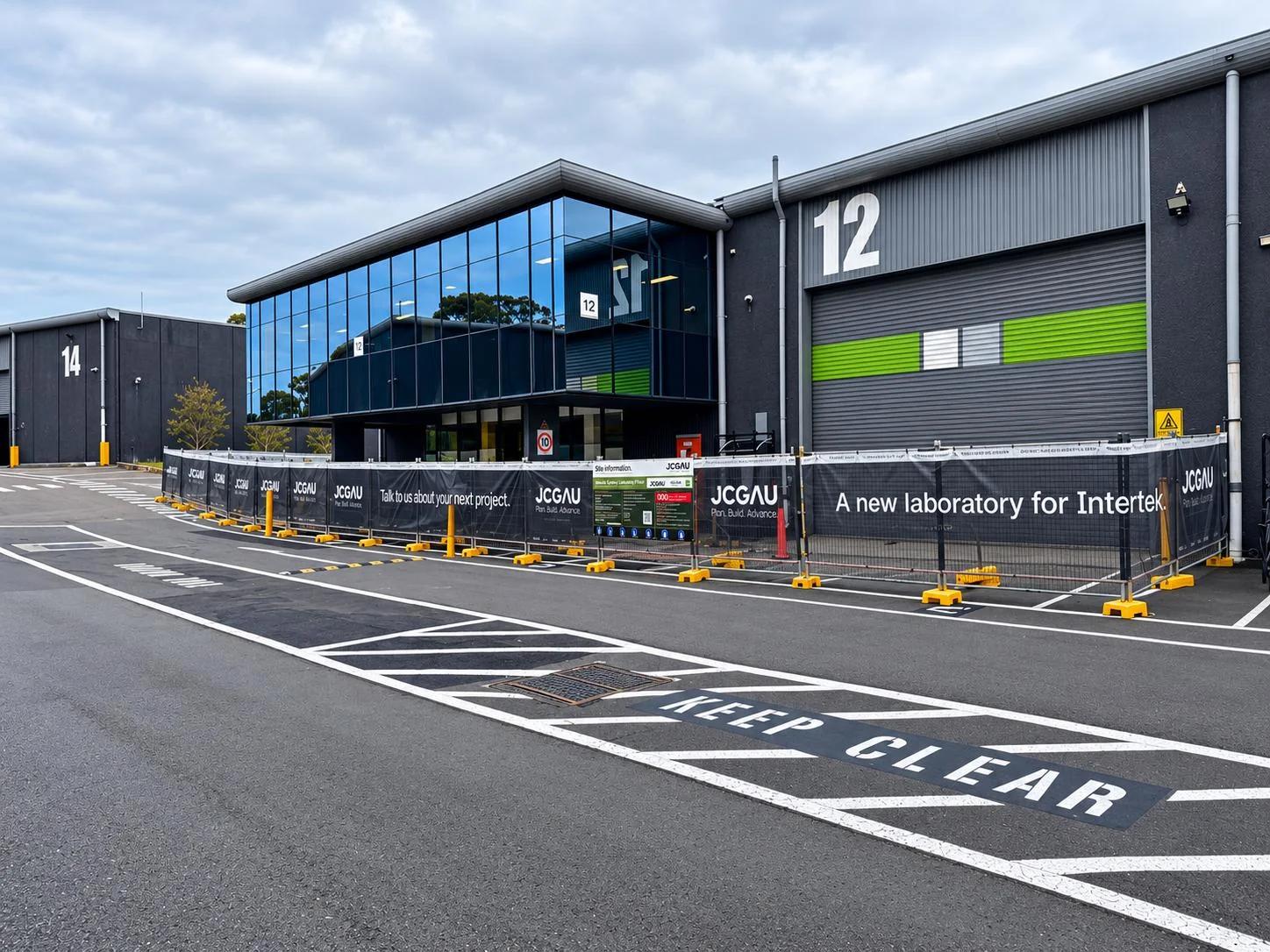 JCGAU
Labs & Research Facilities
Intertek Sydney Laboratory
Intertek Testing Services · Botany, NSW · In progress
- JCGAU
Labs & Research Facilities
Intertek Melbourne Laboratory Feasibility
Intertek Testing Australia · Melbourne, VIC · Delivered
- Prior firm
Aged Care
AVEO Carisfield
AVEO · Complete
- Prior firm
Aged Care
AVEO Riverview
AVEO · Complete
- Prior firm
Education
Le Fevre High School
The education department · Complete
- Prior firm
Education
Mount Barker High School
The education department · Complete
- Prior firm
Education
Parafield Gardens High School
The education department · Complete
- Prior firm
Education
SAE campus
Navitas · Complete
- Prior firm
Education
St Columba College Stage 2
Complete
Prior firm: the director’s contribution at a previous firm, not JCGAU-delivered work.
Also within commercial construction
Design & Construction
One point of accountability. The design and the price move together. Design and construct, and novated design and construct, for commercial projects.Fitout & Refurbishment
Office, workplace and commercial fitout, including staged refurbishment of buildings that stay occupied and trading.End of Lease Defit
Back to base building, documented against the lease. Strip-out and make-good for commercial tenancies, scoped from the lease and priced line by line.
Related
Design & Construction
One point of accountability. The design and the price move together. Design and construct, and novated design and construct, for commercial projects.Fitout & Refurbishment
Office, workplace and commercial fitout, including staged refurbishment of buildings that stay occupied and trading.Delivery Models
Turnkey design and construct, with no client-side manager required. Four ways to buy a building, and what each one leaves on your side of the table.
Where to go next
Design and construct
One contract carrying both the design and the price.Fitout and refurbishment
Working inside an existing building, including one that has to keep operating.End of lease defit and make good
Scoping, pricing and executing the obligation before the lease date decides it for you.Commercial construction
Offices, retail, hospitality and institutional work, from fitout to new build.Delivery models
Construct only, design and construct, managing contractor and early involvement.
Questions
Can you help before we own the site?
Yes, and it is often the most valuable point to be involved. Feasibility, buildability and an order-of-cost view before a purchase decision is cheaper than discovering the constraint after.
Do you work with our architect, or do you bring your own?
Either. On a traditional contract we build to your consultant team’s documents. Under design and construct we can bring a team or take yours across by novation.
How early do you need the design finished?
Not finished. Resolved in the right order. The elements that get fabricated need to be designed first, and finishes can be settled much later than most people assume.
What is the most common cause of a blown programme on a new build?
A service connection or an authority referral that was not identified at the start. Both are visible in week one to anyone who goes looking.
Send us the site and the use.
With those two things we can tell you what the approval path looks like, what has a queue in front of it, and where the programme risk actually sits.