Design and construct, for buildings that are really equipment enclosures.
The dominant procurement model in Australian industrial construction, and the one where the quality of your brief decides everything that follows.
- Contract covering design and delivery
- 1
- Project capacity under a single contract
- $20m
- States we build in: South Australia, Victoria and New South Wales
- 3
- Of design decisions recorded against your brief
- 100%
The premise
Industrial design and construct lives or dies on the performance brief.
An industrial building is bought for what it can do, which means the brief can be written in numbers, and should be.
Commercial buildings are hard to brief in performance terms because much of what a client wants is qualitative. Industrial buildings are the opposite. Pallet positions, throughput, clear height, floor loading, vehicle movements and connected load are all countable, and every one of them fixes a building element.
Which is why a vague industrial brief is such an expensive document. Under design and construct the contractor is answerable to the brief rather than to a drawing set. If the brief says “good clearance”, the contractor has been handed the decision, and no amount of disappointment at handover changes what was agreed.
Diagram contrasting a weak industrial performance brief with a strong one. A weak brief asks for a large modern warehouse with good clearance and adequate power, none of which is testable. A strong brief states pallet positions, rack configuration, the materials handling fleet, throughput at peak, vehicle mix, connected load and the commodity to be stored, each of which fixes a building element and can be tested at handover.
A brief that cannot be tested
- “A large, modern warehouse”
- “Good clearance”
- “Adequate power”
- “Quality finishes throughout”
Nothing here can be failed at handover.
A brief that fixes the building
- Pallet positions, and the rack configuration that delivers them
- Materials handling fleet, by model
- Throughput at peak, in and out
- Vehicle mix and the largest vehicle
- Connected load, and what is on it
- The commodity, and how it is packaged
Why it matters under design and construct: under a traditional contract the drawings define the building. Under design and construct the brief does, so a brief that cannot be tested is a building you cannot reject.
How we work
We would rather help you write the brief than price around a weak one.
- InterrogateWe ask the operational questions first. Fleet, racking, throughput, commodity, vehicles, and we keep asking until the answers are numbers.
- TestThe rack layout is drawn against the building before the building is designed, so the column grid serves the racking rather than the racking working around the columns.
- CommitDesign decisions are recorded against the brief item they satisfy, so at handover there is a line-by-line answer rather than an argument.
- VerifyCommissioning and demonstration against the briefed performance, not against a general impression that the building looks finished.
The equipment interface
The suppliers who are not in your contract, but govern it.
- Racking supplier
- Ordinarily contracted directly by the owner or tenant. Their tolerance requirements govern the slab, their layout governs the column grid, and their rack height feeds the sprinkler design. They are not our subcontractor and their programme is not ours to compress, which is precisely why their dates go on our schedule and get reported.
- Materials handling supplier
- Sets clear height, aisle width and floor loading. A change of fleet after design is a change of building.
- Automation and conveyor
- Where automation is involved it usually arrives with its own structural, power and access requirements, and often its own installation contractor. The interface has to be drawn, not discussed.
- Refrigeration
- Cold storage brings insulated panel, floor heating to prevent frost heave, condensate, defrost and a substantial electrical load. It changes the building fundamentally rather than being an add-on.
- Who coordinates
- Someone has to, and it is rarely the best use of the client’s time. Under design and construct we take that role explicitly and put it in the contract rather than leaving it to goodwill.
Under design and construct, a brief that cannot be tested is a building you cannot reject.
Projects
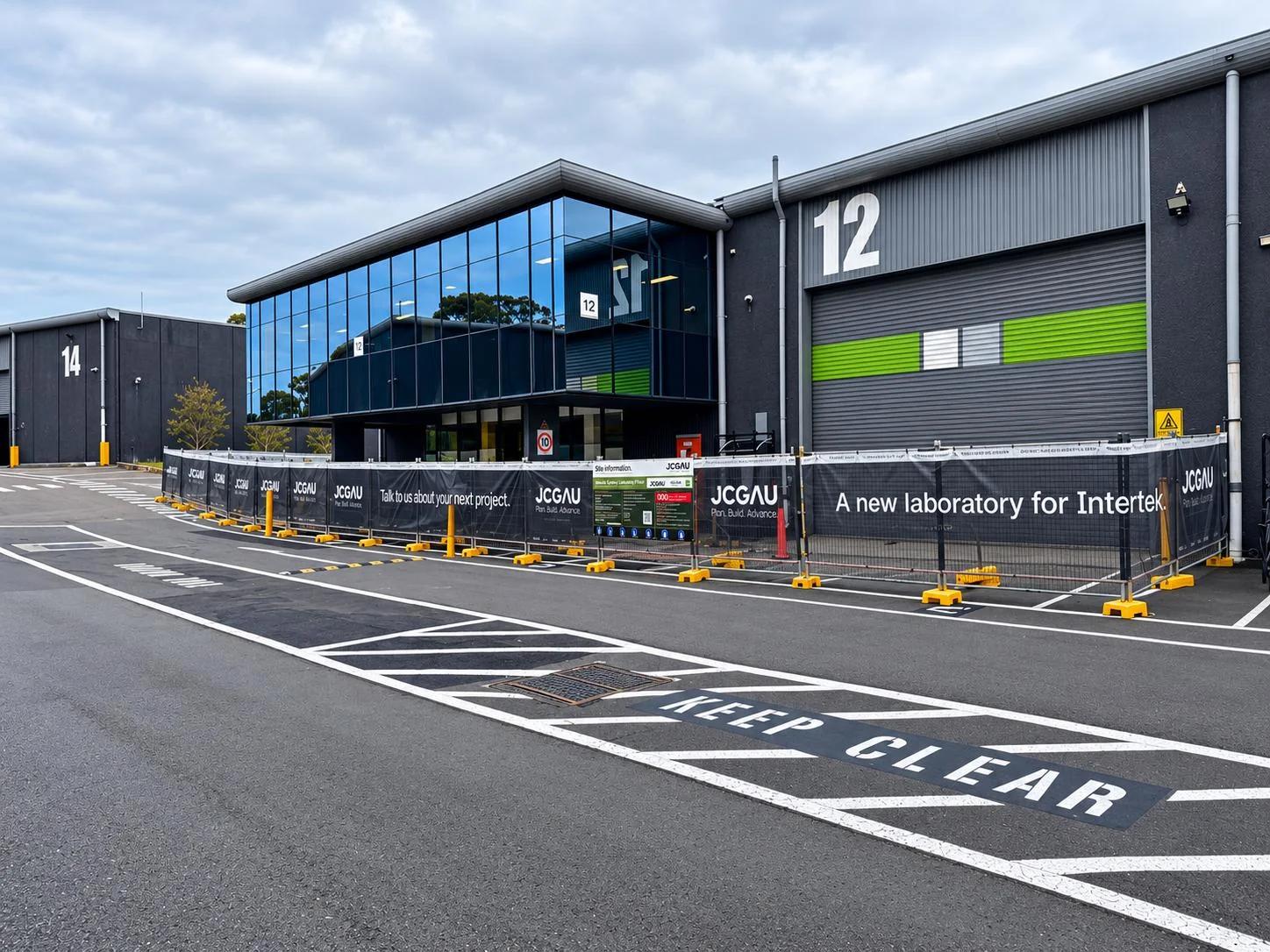 JCGAU
Labs & Research Facilities
Intertek Sydney Laboratory
Intertek Testing Services · Botany, NSW · In progress
- JCGAU
Labs & Research Facilities
Intertek Melbourne Laboratory Feasibility
Intertek Testing Australia · Melbourne, VIC · Delivered
- Prior firm
Aged Care
AVEO Carisfield
AVEO · Complete
- Prior firm
Aged Care
AVEO Riverview
AVEO · Complete
- Prior firm
Education
Le Fevre High School
The education department · Complete
- Prior firm
Education
Mount Barker High School
The education department · Complete
- Prior firm
Education
Parafield Gardens High School
The education department · Complete
- Prior firm
Education
SAE campus
Navitas · Complete
- Prior firm
Education
St Columba College Stage 2
Complete
Prior firm: the director’s contribution at a previous firm, not JCGAU-delivered work.
Also within industrial construction
Industrial New Builds
Portal frame, hardstand and the services that make the warehouse work. Greenfield warehouses and manufacturing facilities.Industrial Fitout & Refurbishment
Office, amenities and plant inside an operating facility. Re-racking, dock upgrades, cold storage, plant rooms and services replacement.Industrial End of Lease Defit
Strip-out and make-good, with the waste stream accounted for. Slab, coatings, racking, bunding and external areas scoped from the lease.
Related
Industrial New Builds
Portal frame, hardstand and the services that make the warehouse work. Greenfield warehouses and manufacturing facilities.Design & Construction
One point of accountability. The design and the price move together. Design and construct, and novated design and construct, for commercial projects.Delivery Models
Turnkey design and construct, with no client-side manager required. Four ways to buy a building, and what each one leaves on your side of the table.
Where to go next
Industrial new builds
A warehouse or facility built around the operation going into it.Industrial fitout and refurbishment
Office, amenities and production areas inside a working industrial building.Industrial construction
Warehouses, distribution and production facilities, and the fitout inside them.Delivery models
Construct only, design and construct, managing contractor and early involvement.
Questions
We do not know our throughput yet. Can we still use design and construct?
Yes, but the brief should say what is known and what is provisional, and the provisional items should carry a decision date. Silence is what causes the problem, not uncertainty.
Can you novate our existing consultants?
Yes. On industrial projects it is less common than in commercial work, but where a specialist consultant has developed the operational design it is often the right structure.
Who owns the risk if the racking will not fit?
That depends entirely on whether the rack layout was in the brief. If it was, it is ours. If it was not, it is a conversation nobody enjoys, which is why we push to have it in.
Do you offer early contractor involvement?
Yes, and on industrial projects it is usually the better value. Involving a builder while the operational brief is still forming is worth more than involving one after it is fixed.
Bring us the operation. We will help you write the brief.
A brief written in numbers protects you whichever builder you appoint. We would rather you had one than not.